Sunday, November 16, 2014

Some Farm Updates; With Love.

      We've been so busy lately it's hard to find time to sleep these days, nevermind get a blog post up.. But here is a quickie to give you some insight into all the work we've been doing!


      Inside the barn we've been getting the lounge, boarder tack room and arena ready for winter use... With our lockers all ready and heaters finally in place, we're getting cozy!
      Our footing is finally drying and settling in, so we moved our poles and jumps into the arena. It's been a blast to ride in with the weather turning so quickly.


      Outdoors we've been building shelters for our herds living outside 24/7; and they have turned out great! Big enough to house 6+ horses without any issue. Next week when our straw order comes in we'll be fluffing up beds for them too.

      We've finally got a grip on these hay nets and everyone enjoys their lucious hay every day and night; while still getting to move around from feed station to feed station! Next we'll be putting up posts and hitch rings for the nets to hang off the ground over the winter months. With a few going in the shelters too. Everyone loves breakfast in bed!

      And lastly we brought in 30+ tonnes of round stone gravel for all of the paddocks to fill in any mud spots around the water troughs, shelters and fence lines. I love the results we are getting already! The horses choose to walk on the round stone instead of the mud and it doesn't freeze rock solid like the muds does. Their hooves are getting a great chance to transition into the harder ground instead of the usual winter shock of soft grass and mushy mud to hard as rock mud rivets. All the while getting tougher by the day with the added bonus of naturally wearing down. We are already seeing hooves harden, soles growing back in, toe callus formation and less to trim each time our barefoot trimmer comes up. Keep an eye open for our monthly updates following our horses transitions into real barefoot living! Remember, just because you took shoes off your horse doesn't mean they are really barefoot. You need to properly manage their living and access to harder terrain types to keep those hooves strong and allow for a proper callous to form. Otherwise you risk soreness and the inevitable unsound, bruised hooves we've all come to hate!

That's all I have for now, expect a new post later this week... I have some ideas brewing!

Much love.
Jesse


Saturday, November 1, 2014

Why My Journey is a Bitless One...

      I'd like to start this post off with the disclaimer that I do NOT look down on anyone who chooses to use bits; but I do however challenge them in their horsemanship. A bit is a final refinement tool, not a control device. If you cannot ride your horse around a ring at the walk, trot and canter on the buckle; you don't need more leverage, you need to go back to the basics!
      A bit is a tool used to refine a horse's movement and to further your communication with them. If you can't communicate with them on the ground, and in a casual riding environment in the saddle.. You are not ready to have a bit.

      That said, I'd like to share why I am on a completely bitless journey with all of my horses and my students. It all started with my first horse, Johnny. As if he hasn't taught me enough!

      It's funny, everytime I start a new student with a difficult horse; we end up going down the same road I went down when I first was shown how to go bitless...

      When I first bought Johnny he was coming off of time in the pasture, but he had a good amount on training on him. I rode him in a simple single jointed snaffle and things were pretty ok. He had his moments, but overall wasn't a very difficult ride. But as we progressed into more refinement in our training, things got more and more difficult. He wasn't disobedient, he was terrified. Everytime I asked for contact or collection, he would jolt forward and throw his head up in the air. Take off, freak out, scare me to death... And I always got a similar answer as to why he was like this; "He's a thoroughbred", "he's too hot", "he's being disobedient" etc etc... But I knew this wasn't the case with him. I could do so much with him on the ground, and he was connected to me. We had a very good relationship even through rough times; he had no reason to suddenly become sullen under saddle.
      Under the advice of different trainers and coaches, I tried a selection of different bits. A single jointed copper roller (which ended up being THE WORST for him, almost landed me in the stands one night), different combos of single and double jointed snaffles, happy mouths, rubber, copper, sweet iron... I tried a very soft french link, and a second level Myler comfort snaffle. But the result under saddle was always the same. Hollow backed terror.
      At some point during this battle through bits, I reunited with my NH coach and she took me down a new road. She pushed me to try bitless. I had just moved Johnny to her farm after finishing school and I was mentoring with her. I was riding horses every day in bitless bridles.. but with Johnny I was absolutely terrified at the idea. How would I control him when he decided to take off? What would I do to stop him when he decided to jump out of the sand ring?
      But she just laughed at me, and pushed me into a lesson. And the result was the same result that I get every time I push one of my students to try bitless with their horses...
      Absolute shock and astonishment. But how? How can they be so soft? Is he rounding?! Sitting back and relaxing even? We did a full lesson walk, trot and canter in the most relaxed frame of mind (and body) I had ever experienced from him. No terror. No panic.. no pain.

And I've never looked back. Ever.

      It's funny to me now because I think of how scared I was to try something new. Something that I did not totally understand at the time, and had only really experienced from afar. And because of it's stigma, had deemed myth. But here I am, with a facility full of bitless horses. And I wouldn't have it any other way. Johnny showed me that bad hands had ruined his mouth, and no matter how soft a bit or working hands could be; they would not shake his past. This is why I choose bitless. Not only because I believe all of that refinement is totally possible without a piece of metal in their mouth, but also because it allows room for bad hands to create torture in a horse's life.
      And yes, I hear it all the time. But a bit is just a tool, and a bitless bridle in the wrong hands can be bad too. And it's true. It most definitely can be. But there is no way you can tell me that a jointed piece of metal (nevermind two) is softer than a padded piece of leather. Test it! Put a bit on your wrist (the boniest part) and tap it around, pull on it, push on it, bend it up and down and pinch your skin with it. Now get a padded leather noseband and do the same. Point made? Point made.

      With that said, there are a million different types of bitless bridles. And there are a million perspectives on each one. And to this I say, as with all things, to each their own. This is just my opinion. My experience and my perspective. It's right for me. And that's all I can say about it! But from my experience in trying new bridles over the past couple of years, here is what I do with my horses.

      I start all horses in a rope noseband sidepull. This is a very simple bridle, with easy questions and easy answers to find. It is soft with no contact, but can be very strong if needed for emergency stops. It also lends the hand of pushing horses up off their forehand if they tend to lean on your hands. It is the very basics of pressure; it makes the right answer easy to find, and the wrong answer uncomfortable. There is no bridle I feel safer in. I have no doubt in my mind that I could stop just about any horse (with foundation ground training) under saddle in this bridle. It is my go to, and also the bridle that every student begins in. This bridle teaches you basic steering with minimal touch on your horse's face; and forces you to use your body as your main aid. You cannot lean on your hands, you cannot rely on steering for everything. It encourages a loose, casual rein; which encourages relaxation in your horse.

      Step two is into a simple leather noseband sidepull. Basically the same as the rope, but allows the horse to lean into the noseband a bit more with comfort. And thus lays the foundation to search for contact. This is a bridle you move up to when you have proven you can go walk, trot and canter with your horse with a loose rein and good connection; in any environment.

      Step three is into a padded noseband hackamore. Only those looking for "contact" and "collection" need to move up to this step. It is one I am just reaching myself, and with only two rides on Johnny in one.. I am inlove! Johnny had started looking for contact when we were in work last year, but I didn't know what options I really had. I have found every bitless I try online from different countries.. And the one I have chosen for this step is the Zilco flower hackmore. It's padded, and fits nicely. And it allows you to configure your "contact" to best suit your horse. It's almost like an elevator bit where you can choose what level of leverage you want/need. So far I haven't felt any real difference in my mechanics with this bridle in comparison to riding with a bit. The contact weight is the same, the hand aids are the same... but my horse is seemingly happier and no more taking off!


      Our next aim is to get our bitless show team out into the area and showing what we can do! With hopes of being allowed to ride in higher level events which require a bit to show. I have some girls dying to try eventing but whom aren't allowed to show because we need a bit for dressage...
Here's a great article about that whole ordeal!

To Bit or Not To Bit - Dressage Naturally

And here's a quick video of Johnny and I in our first ride in the Zilco flower hack. Don't mind how out of shape we are, we're working on it!
Much love!

Monday, October 27, 2014

The Problem with Performance VS Pet

      It comes up all the time, whether you are a performance athlete with your working horses, or if you are a loving gooshy pet owner. Here's the problem, anyone who wants to have a performance athlete should be both.

Why?
      Because horses are not meant to just be serious, in the moment, always focused working athletes. We do not expect this of our human athletes, ever. And there's good reason. Being focused, having to work, and not being able to "play" will burn you out pretty fast. Stress is useful when used in the right manner, but being a performance athlete has a lot of extra stress with it. And everyone, yes even our horses, need a chance to burn out that steam!

      Imagine if human athletes had to purge their entire social, entertainment and pleasure filled lives to only live, eat and breathe their sport? Yes, we expect a lot of these athletes, but they do not live in their homes at all times unless they are working out at the gym. They are not segregated from all human contact except that of their teammates. They still go for beers with their team mates, they still go out and relax outside of working out and training.

Did I mention this is where ground games come in?
      Teammates go out and burn off steam together away from being totally focused on their sport. And horses need the same. And so do you! Taking time off from "working out" and playing with your horse is not only a great act for your training, but it's a great way to bond with your TEAMMATE. Yes, your horse is not a piece of sports equipment! It's a living, breathing soul who needs many of the same enrichments that you do. Beyond the obvious need for food and water, they also need companionship, socialization with their fellow herdmates and down time (and I don't mean standing in a stall all day). While they can get many of these things from being out in the herd, companionship with you can be worth a lot towards your performance goals.
      Team mentality is a proven performance builder (corporate companies pay big bucks to send their workers to "Team Building" workshops because it's been proven to boost morale and performance!) Playing games together allows you to build synchronization with your horse, as well as understanding who they are under all that handsome fur. Knowing who your horse is, is just as important as knowing how to move your horse around a jump course. Knowing what makes them tick, how to motivate them and how to ask for that last bit of umph are all great assets to your show career.

      So why do we allow this stigmatism and condescending attitude prevail? With something so useful to us all, we should be embracing the idea of caring about our mental partner.. Not just the physical one.

      Seek balance with your equine partner and push a bit of empathy towards how they live when you aren't around. Spending a bit more time with them outside the saddle can make a world of difference for their quality of life.


Wednesday, September 24, 2014

Three Years Post Concussion; Why I Need Natural Horsemanship

      On September 26, 2011; I had an epic fall off my heart horse and injured myself worse than I have ever before. I hit my head so hard I went unconscious and caused a cyst to develop in my left temporal lobe. I was up and down between being bed ridden and trying to be a real person for 6-8 months after this day. And it has changed me forever.

      It made me work through a lot of my own being. I worked through my fear of horses, my fear of riding again... But it also proved to me where my heart is. I learned how it was my own fault, and it put me on a perfect path to Natural Horsemanship. A path that will forever have my feet trudging along it in search of more feel and better connection. I learned so much about myself, and about how to start working more effectively with my horse.


      Natural Horsemanship is what brought me back to the light, it set my stage to become a trainer and to continue what will be my life's work as an ambassador for NH training, and Natural Horsekeeping. I have more tools in my tool box from the past 3 years of NH education than I have from my 15 years of English riding instruction before that. With the aid of a successful mentor, clinics and self education, partnered with certifications from schooling; I am all the better Jesse today than I was as I stepped up into the saddle that day 3 years ago.
      I often wonder where I would be now if I had started my entire horse journey with NH. What would I be capable of now if I had started a feel when I was 6 years old... I have always been looking for a connection, my entire life with horses I have been begging for that knowledge, for that spiritual sense of connection. But there wasn't anyone teaching it at that time.. It wasn't available to me. So now I will be available to all the little equestrians looking for that feel, that connection. And not just because it makes them better in the show ring, because their souls call for it.. because they know it is what horses are here for. To help us grow.
     
      I am thankful for my concussion, if that can make any sense whatsoever to anyone.

      Without it I wouldn't have struggled through so much in my life, my relationships, my heart and my soul. I wouldn't have been driven to buy my horse, go to school, start training to be an NH trainer, and I wouldn't have the man of my dreams next to me either. Without that literal fall to rock bottom, I wouldn't have been able to rebuild myself into someone I quite admire today. I am so proud of myself for taking the big hint and getting a clue. Where would I be now if I hadn't been forced down this path? Would I have my own facility? Would I have a herd of horses out back? Would I have my family close and motivated with me?

      Who knows! As much pain as I went through in that time, I am reaping every benefit of it now. The only downside I face now is my innate fear that pops up from time to time. But with the right support team, the help of sports psychology and my NH mentors; I am working through it every day to better myself.

To finish off, here is a post I wrote about conquering my fear and my first step back into the saddle after my fall.


Trust is something you work for. In yourself and in your horse. You have to take care of it daily, sometimes hourly and moment by moment. But it is the most important trait you will ever come to know in life. Cherish it. And keep it burning.


Monday, September 22, 2014

Emotional Fitness Clinic has Given Me Endless Inspiration!


      Last weekend I attended one day of a two day Emotional Fitness clinic put on by our local Parelli instructors; Todd and Maureen Owens who hosted the incredible Dr Jenny. She is a sports psychologist with the most amazing views on self help, healing and understanding ourselves so we can better understand our horses. She talked about a lot of amazing ideals, character traits and day to day actions we can do to help ourselves become more emotionally fit. But one thing she talked about which struck a major chord for me; is how little people are really in tune with their horses.

      I am just as guilty, as I went home and thought about everything she had said. How we need to take breaks in our training sessions so our horses can digest what we've been telling them, and working them through. How we need to stop and really observe our horses so we can look for tell tale signs of tension, fear and confusion. This pushes past just the ability to ask a horse to do something and having them react, we're talking about having a calm and collected horse who understands, digests and then responds to your cues. Tension and stress free.

      It was so interesting to see her working with different riders and trainers to pin point their issues and to work through them together. There was one lady who had her horse doing wonderful patterns and who was obviously very obedient... but after a few patterns we all came to realize what she did not. Her horse was actually very tense. This mare was reacting to very small, easy cues; and doing all of the patterns with ease. But she never relaxed into anything. She was always very tight necked, her tail was clamped, her legs were choppy.. And those were just the really noticeable traits from afar; there were more tell tale signs close up that Dr Jenny gave advice on.
      How do we know when our horse has really relaxed into work? When are they 100% on and ready for work; cool, calm and collected. Responsive and ready for action. This is where Dr Jenny stressed our need for better observation of our horses. Here was a seemingly wonderfully trained horse, who was living with stress 90% of the time during work. And to no fault of her owner, she just didn't know! She thought, well if my horse is answering my questions and working through what I ask of her, she must be ok with it. But she wasn't.

      It's not hard to take the time to recognize stress in our horses, or to even take a break and bring them back down. Passed that it's not very difficult to work them out of that state, and into a relaxed mode in both their body and mind. This is where we want them to be anyways!

      This lady took advice from Dr Jenny, and from Todd; and worked on how to be in tune with her horse. She learned to wait for her to lick and chew after every movement; which in the beginning took upwards of 10-15minutes. She learned to embrace her calm self, and how to ask for that calm self. And she also learned about her own walls that had been blocking her from seeing her horse's stress in the first place. She learned she was very much an LBI and needed to stop worrying about the big picture check list (circle game, check. yoyo game, check.) and instead focus on her horse's attitude and mannerisms. Is she relaxed? How do I know? Is she tense? High headed? Is her tail loose and swinging? Is her back tense and choppy? Are her eyes blinking and thinking or stuck open in shock?
      These are all things we need to start doing on a regular basis with our horses in everything we do. Because the more we tune into these qualities, the more quality we will start to see in our horse's work. Who works out and studies better when they are relaxed and comfortable? *raises hand* It's the same for our horses.

      I want you to look at your own training and riding; think back to times when you've maybe pushed your horse passed their relaxed threshold and into a stressed environment. Don't get me wrong, as Dr Jenny has said, stress isn't a bad thing; it's a biological imperative. But we need to be aware of when we're asking for emotional fitness, or when we're ignoring our horse's signs of being uncomfortable. Just because your horse allows you to climb up on their back, doesn't mean they are entirely relaxed in the process. Just because your horse allows you to stand up on their bum, doesn't mean they are comfortable with the idea. Are they standing cool, calm and collected because they are relaxed? Or are they frozen in shock or fear?

      My biggest advice is to look at those ears, paired with those eyes. They will tell you about a world of emotional thought in your horse. So next time you go to work with your horse, make sure you are waiting for those licks and chews, make sure you are giving them a few breaks here and there, and most of all make sure you are tuned into their comfort levels and wait for that relaxed demeanour before moving forward.


      I took this advice and had an incredible break through with a client's horse this past week. It was one of the most inspiring moments of my training career, and I've only just begun!

As always, keep on keepin' on!

Friday, September 19, 2014

Pasture Love

      It's been about 7 weeks now, and we are well under way with all forms of maintenance, repairs and building new things on the farm. But my day to day operations always include some form of pasture maintenance. It's hard work, long hours.. pretty stinky too. But I prioritize it as one of the most important things to be kept up with on the farm.

      Ever see over crowded paddocks with horses standing in a foot of mud? Sick of it?

      Yeah, me too. Because at this point, with all of the information we have on the topic; there is really no excuse for it. Keeping a pasture full of green grass, shrubs and the right mix of sand, gravel and dirt is so important for the health of our horses.

Why is it so important?

1) Parasite Control
      Your worming program is only as good as your poop maintenance plan. You can deworm your horses all you want, but if you aren't actively removing that poop from their dinner plates; you are just proliferating the issue. Most dewormers don't actually "kill" parasites/worms when you deworm your horse; they most often than not are used to cause the worms to leave your horse's system instead. That means when they poop out those worms, they are still alive. And some are still very capable of laying more eggs, or infecting your horse all over again. These worms need to be exposed to the heat of the sun, or removed from the pasture altogether and left to bake in a compost pile.

What do we do at NRE?
      We pick and clean the paddocks from manure on a weekly basis. We are lucky enough to have a gator vehicle with a self dumping bucket on the back. So we drive into the paddocks, scoop up the poops with pitch forks (yes, labour intensive but soooo worth it) and then go dump everything in our manure pile/compost pile.

2) Horses don't eat poop covered grass
      Ever notice that if you leave your horses out in a pasture long enough for them to eat all of the grass up, that some spots get left over grown? They avoid those areas like the plague. And for good reason. That's their washroom! They urinate and leave their poops there. They have their own natural instincts built in to avoid those areas because that's where parasites live; waiting for a hungry mouth to nom them up and give them a new warm home. This is another important reason to remove manure from your paddocks, so that all of the grass has a chance to be rid of parasites, and so the horses can rotate their "washroom" areas and have full access to all of the yummy grass in the field.
      Another great idea after removing the poops from these areas is to give them a good weed whack or mow. Not too short, but enough that anything lingering in the moist tall grass has a chance to dry out. This is a great area for mold to form, and if horses are left to their own devices without another source of food. They will turn to eat these areas if the other areas have been eaten down to roots. Forcing a horse to eat molding grass and parasites isn't the best way to create a healthy environment.

What do we do at NRE?
      Depending on the time of year, the grass grows at different rates. But just about every other week we'll go out after removing poop piles and run the mower over the long parts in the pastures. Especially effective to do this on a hot dry day.

3) Mud.
      Poop build up creates mud. It kills grass... that mixed with the ground moving hooves of your horses; creates perfect areas for mud to set up camp. This happens especially fast to those who have too many horses in their paddocks, or who setup their paddocks so everything the horse needs is in on tiny little area.
      Remember that not ALL mud is bad either, some mud is good. Horses love to roll in mud to help cool off, and to keep the bugs off. It's a natural part of their grooming behaviour, so leave a good rolling spot for them.

What do we do at NRE?
      Keep herd numbers smaller, and have the option to rotate paddocks to give each pasture time to heal and regrow. It's important to keep an eye on the grazing fields so as to not allow the horses to kill the grass by eating too much of the blades. When the grass is short enough that it starts to burn, you need to give it some time off.
      Put your water trough far away from your shelter, and your salt blocks far away from those too. Your horses should be moving around a lot, every day. If you put everything close together, they are going to congregate there and too much movement in the one area will kick up the ground and become mud.
      Get some sand and gravel in your paddocks. Not only is this great for your horses bare feet, but it's also great to keep water from pooling into muddy areas. Gravel is best placed along fence lines that show a lot of wear from horse paths, around water troughs, feeding troughs and around your shelters. Sand is also a great spot for rolling off those itchy spots. I like to leave one big spot with just clean sand for the horses to play in. They love it!

4) Weeds
      Not all weeds are bad, and not all weeds are good. Make sure you do your research so you can recognize a bad weed from a good one. Horses like and need variety in their diet; and weeds and shrubs are a great way to allow them this freedom of choice to eat. Bad weeds need to be removed by the root, and left to dry in the sun out of the paddocks and then burnt in a safe manner. Good weeds can be kept under control by regular mowing and weed whacking; or with the use of other paddock companions like donkeys and goats.


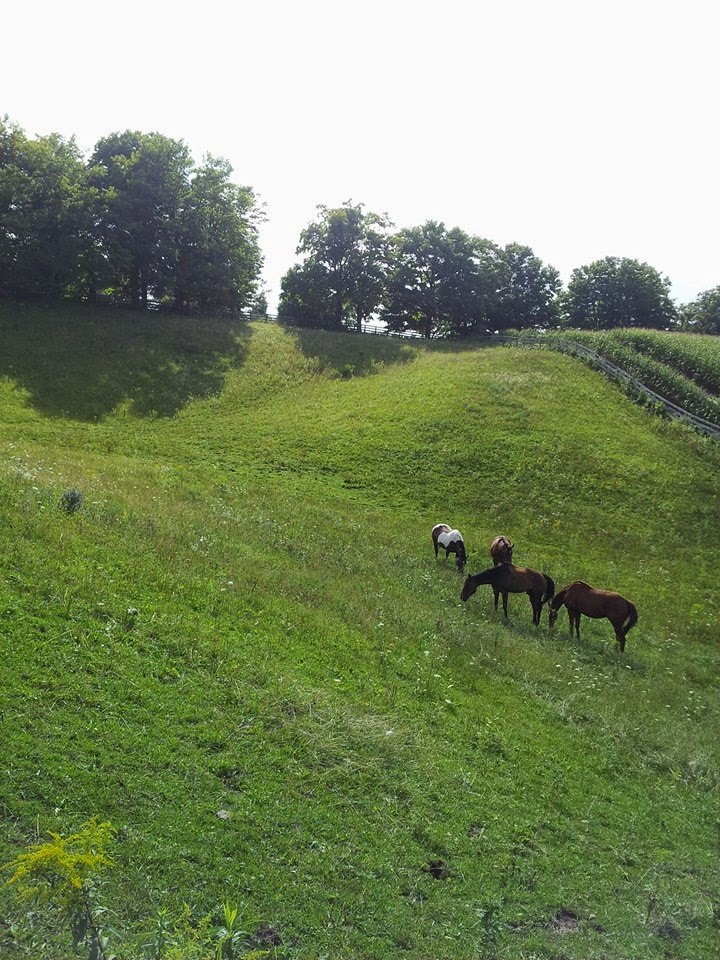
     So what can I say? These are just a few of our happy horses, in their happy pastures!


Anyone have some pictures of their own happy pasture buddies to share?

Keep on keepin' on!


Thursday, September 4, 2014

Nature's Run Equestrian: 1st Month of Adventures

Welcome to Nature's Run Equestrian!
We officially open for business on October 1st!


      Our first month here has been eventful to say the least so I haven't had much time to write anything about our adventures. So I thought I would give a quick update to the goings on! And show off some nice pictures as we go.
      We got our full load of hay in, 1500 small squares and stacked into the barn during our first weekend here. My poor family got their first taste of hay work, we started the first day with 5 of us, and were down to 3 of us after 6-7 loads. We managed 1000 bales in the first day, with 5 left on the second. But we all survived!

      Our second week here I woke up to a flooded barn from a burst water line for the automatic waterers in the stalls. Luckily we didn't have any horses in, but the bottom layer of some of my hay stalls got soaked!


     We swept all the water out, and dried up everything as best we could.. what a work out!

      We've been working away at all of the paddocks and taking out all the weeds, planning new shelters, and putting up the new tack room!

This is one of the paddocks for indoor boarders, finally all cleared and mowed.

This is the big hill paddock by the road where my 4 geldings reside in utter bliss.

This is Johnny and Spirit helping with the paddock clean up!

Q enjoying his new digs.

My two newest OTTBs Floyd and Zeppelin on quarantine as new arrivals.

Our freshly mowed grass ring leading to the sand ring (which is still being weeded out!)

And at the end of the day I get to look out on this....

It's pure bliss here!

Keep on keepin' on,
Jesse